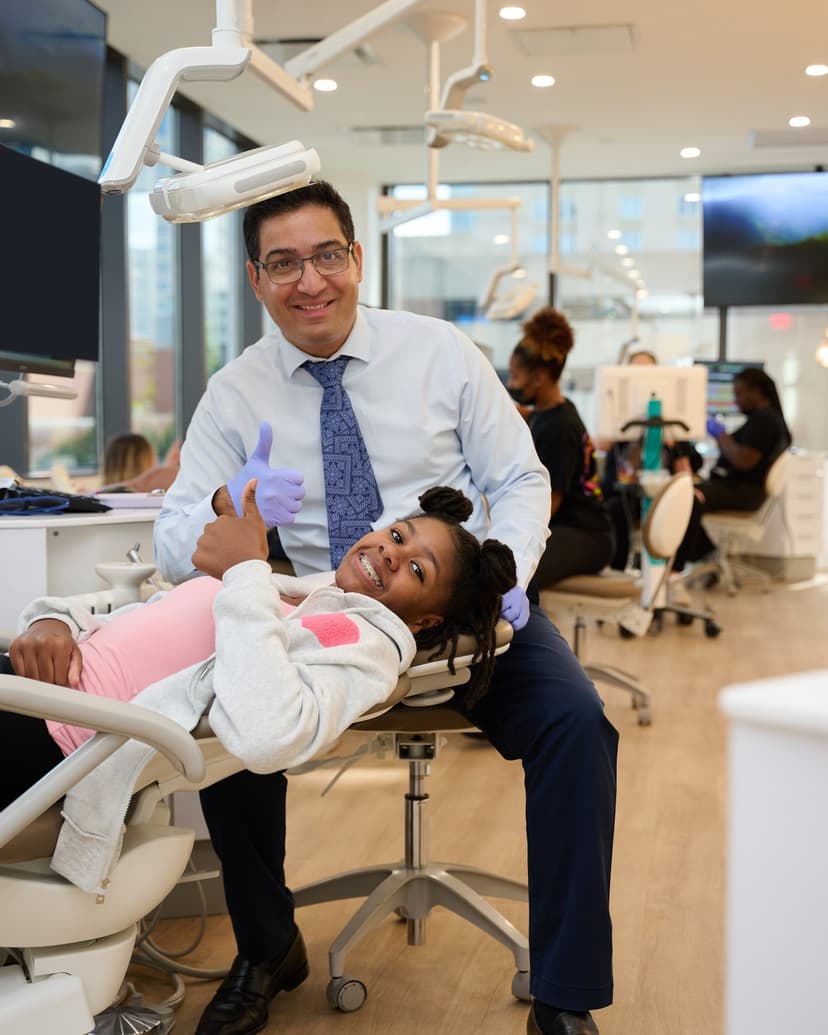
Airway and breathing
Airway, breathing and orthodontics
Orthodontists can spot signs that may be linked to breathing problems, such as a narrow upper jaw or mouth breathing. We screen for these signs, plan treatment with them in mind and refer to medical specialists, who diagnose and treat breathing and sleep problems.
Signs worth mentioning at your visit
Tell your orthodontist if you or your child notice any of these. They don’t mean there is a problem, but they help us decide whether a medical referral makes sense.
- Breathing through the mouth, especially at night
- Snoring or restless sleep
- A narrow upper jaw or a crossbite
- Waking tired, or daytime sleepiness
- Jaw clenching or teeth grinding
Airway screening at your orthodontic exam
At every consultation, your orthodontist checks for airway-related signs as part of the exam of your teeth, jaws and bite. When a 3D CBCT scan is taken for orthodontic records, your orthodontist also reviews the airway space it shows. A CBCT scan shows anatomy only; it can’t diagnose a breathing or sleep problem.
Orthodontists do not diagnose sleep apnea or other sleep disorders. If we see signs of concern, we explain what we found and refer you to the right medical specialist.
For children and teens: palatal expansion
A narrow upper jaw is easier to widen while a child is still growing. A palatal expander, including the removable Invisalign® Palatal Expander, gently widens the upper jaw to make room for teeth and correct a crossbite. For some children, expansion is one part of a plan coordinated with their pediatrician or an ear, nose and throat (ENT) specialist.
Expansion treats a narrow upper jaw. It isn’t a stand-alone treatment for sleep apnea and doesn’t replace a medical evaluation. If your child snores most nights, talk to your pediatrician.
For adults: part of a team plan
Adults with airway or sleep concerns are diagnosed and treated by physicians, such as sleep medicine specialists and ENT surgeons. Orthodontic treatment can be part of their plan. For some adults with jaw problems, that includes braces with jaw surgery planned together with an oral and maxillofacial surgeon.
We work with your medical team
With your permission, we share records and findings with your pediatrician, ENT specialist, sleep physician or surgeon, so everyone works from the same information.